Category:
AI consulting services
Date Posted:
July 2, 2026

AI consulting services
July 2, 2026
Table of Contents
ToggleAI consulting gives a structured path to help identify, design, and implement artificial intelligence across business operations. It takes AI deployment from concept to a system that produces measurable outcomes against a specific business problem. It pulls businesses out of endless pilot projects that never make it into production.
AI Consulting Services Australia | Beyond Key Australia
Beyond Key offers AI consulting services to Australian organisations, covering AI strategy, solution design and smooth integration with existing systems.
Business operations have grown more complex than manual processes can keep pace with. There is an enormous volume of data generated daily; and customer expectations have shifted largely with instant responses, personalised interactions, and frictionless service across every channel with constant pressure to reduce operational costs.
Traditional systems report on “what already happened” whereas AI shifts that to “what is likely to happen next”, and “what the right response is”.
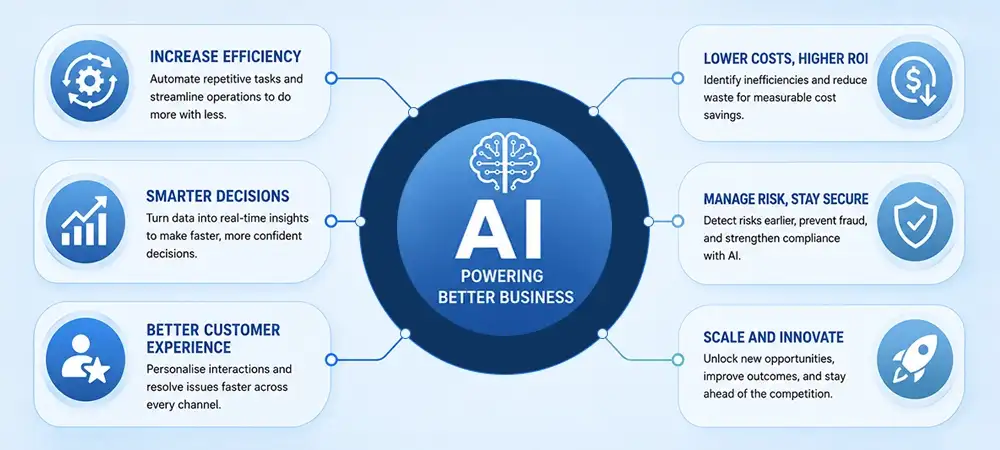
AI automates document processing, invoice approvals, report generation, data entry, and customer query routing so that teams can pay attention to other important projects.
Experienced decision-makers lack timely and accurate input. AI closes that gap, so the decisions are made with real-time data instead of relying on historical information. For example, a retail buyer who once spent three days compiling sales figures can now walk into a meeting with a live demand forecast already filtered by SKU, region, and season.
Customers want personalised experiences, quick responses, and consistent experiences across physical or digital channels. For example, one Australian telecommunications provider implemented an AI triage layer across its support channels. In the same quarter, AI resolved 70% of billing disputes without escalation, lower handle times, and CSAT scores that needed a human agent to take eight minutes to resolve.
Traditional analysis tends to catch problems late. AI identifies inefficiencies in time to enable cost savings across large-scale operations.
Example includes: a national distribution business using AI-based route optimisation to work across fleet was able to cut fuel spending by 18% over six months. The AI system is fed live traffic and load data to re-sequence the deliveries.
AI is used to identify risks earlier and respond to reduce costs, liability, and operational disruption. Like in manufacturing, computer vision on production lines catches defects that human inspectors miss during high-volume runs.
AI adoption across Australia and New Zealand is no longer concentrated in technology companies or large enterprise. It is present across retail floors, hospital wards, factory lines, and logistics networks, in organisations that have identified specific operational problems and applied AI to solve them.
Retailers are using AI to connect signals that used to sit in separate systems to track demand patterns, inventory positions, customer behaviour and make faster decisions on replenishment, pricing, and personalisation like what each shopper sees.
Practical example: Woolworths uses AI to model demand at individual store level, live sales velocity, local weather forecasts, and upcoming community events – all at the same time. The result is fewer stockouts during high-demand periods, less overstock in slow-moving lines, and a planning team spending its week on exceptions.
AI is reshaping how retailers engage with customers. Personalisation engines adjust what each shopper sees as per individual browsing and purchase history.
Financial services generate more transactional data per day than almost any other sector. The cost of making the wrong risk decisions, or missing a fraud pattern, is immediate and measurable by AI.
Real-world example: Commonwealth Bank’s AI fraud detection system monitors the full volume of daily transactions across the network, learning evolving fraud patterns continuously.It identifies behavioural anomalies in real time by flagging suspicious activity before the customer has noticed anything themselves. The AI learns what normal looks like for each individual account and catches sophisticated patterns that fixed rules miss entirely.
For lending, ANZ applies a similar intelligence layer to credit assessment, drawing on a broader range of behavioural signals to get fewer defaults on accounts that should have been flagged, and fewer rejections of customers who represented genuine low-risk lending.
Across the sector, AI is also automating compliance reporting across multiple regulatory jurisdictions simultaneously, reducing the manual reconciliation effort that used to consume significant time from risk and legal teams.
Healthcare in Australia faces rising patient demands, clinical workforce restraints, and improving diagnostic throughput, and getting resource allocation decisions right before problems develop.
Practical example: The Royal Melbourne Hospital uses AI-assisted imaging analysis to scan and flag areas of clinical interest before the clinician review.
Beyond diagnostics, Australian hospital networks are using AI to forecast patient admission volumes accurately to adjust staffing rosters in advance. Bed allocation, theatre scheduling, and discharge planning are all areas where better forecasting reduces operational waste and improves patient.
Manufacturing sits at the intersection of physical operations and data-intensive systems, which makes it one of the clearest environments to demonstrate AI’s ROI.
Real-world example: Manufacturers across Toyota’s Australian supplier network use predictive maintenance tools to continuously analyse sensor data that analyse vibration frequencies, operating temperatures, pressure readings, and cycle counts.
The models identify deviations that correlate with impending failure days or weeks before anything goes wrong. On quality, computer vision systems deployed on production lines are catching surface defects, dimensional deviations, and assembly errors at speeds and consistency levels.
Logistics operates on thin margins across complex, geographically dispersed networks, and dynamic route conditions which don’t apply anymore.
Practical example: Toll Group put AI-powered software across its fleet across route optimisation and operations management. The system reads and adjusts routing as per live traffic conditions, delivery windows, vehicle load, and driver availability in real-time.
As a result: fuel consumption drops, on-time delivery improves, and the operations team spends less time on day-to-day management.
B2B marketing has historically struggled with the gap between the volume of leads a business generates and the quality of attention those leads receive from the sales team. AI changes the accuracy of the output significantly.
Real-world example: B2B teams using AI lead scoring tools don’t just rank by form fills anymore. The signal set is wider like time spent on specific pages, content downloads, email engagement sequences, return visit frequency, and how those behaviours combine.
Two prospects can download the same comparison guide and look completely different. One came back to the pricing page three days later and opened two follow-up emails that week. The other downloaded it six weeks ago and hasn’t touched anything since. Same asset, opposite intent.
The results are shorter sales cycles, better conversion from qualified pipeline, and less time on outreach that was going nowhere.
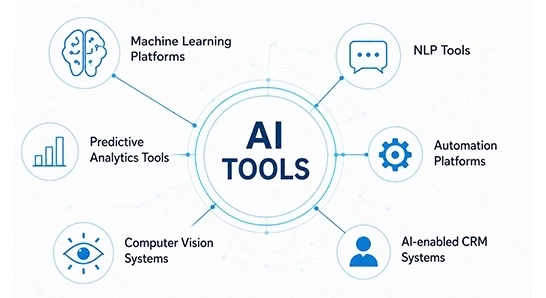
Most enterprise AI deployments draw on a combination of the following:
Tools like Microsoft Copilot can work on multiple tasks across connected systems. By 2028, a significant share of enterprise workflows will have AI autonomously handling routine execution.
Businesses will shift from segment-level personalisation to individual-level with real-time adjustments to pricing, content, and service based on live behavioural signals.
Generic AI tools give way to models trained in industry-specific data. A legal firm’s document review AI trained on Australian contract law performs materially better than a general-purpose language model on the same task.
Australia’s updated Privacy Act obligations around automated decision-making is already reshaping how AI systems are designed and documented. Businesses that build explainability and audit trails into AI systems now will face significantly less remediation work as regulation tightens.
Within three years, AI capabilities will be a standard component of ERP, CRM, and supply chain platforms, rather than standalone capability.
Beyond Key Australia helps organisations design and implement AI solutions that align with measurable business objectives. Our end-to-end approach includes:
Beyond Key Australia brings together technical depth and business consulting to help organisations put AI to deployment. We help organisations implement AI solutions across the Microsoft ecosystem, including Azure AI, Microsoft Fabric, Dynamics 365, Microsoft 365, Power Platform, Databricks, and Snowflake environments.
The case for AI in business is no longer theoretical. The operational and financial benefits are being realised across industries on a scale.
The businesses seeing real returns from AI are the ones treating it as a structured capability investment rather than a technology trial.
The question worth asking now isn’t whether your industry will be affected by AI. It’s whether your organisation builds the internal capability to use it before your competitors do.
AI in business is the use of technology to analyse information, to identify patterns, to highlight risks, and to support decision making. Businesses are using AI to improve their operations, automate repetitive and manual tasks, understand customers better, and extract insights from huge volumes of data.
AI helps organisations turn enormous data into meaningul information that creates actionable insights. AI helps in surfacing risks early, picking customer behaviour shifts, and giving teams answers in real-time.
AI is changing the way organisations operate by telling what’s coming in future. Businesses can skip relying on past reports to predict demand, anticipate future equipment failures, identify fraud, personalise customer interactions, and automate mundane work. This allows the teams to focus on strategic initiatives, rather than manual tasks.
When investing in AI, companies must consider performance, adaptability, and competitiveness. Those companies who do AI right, get benefits such as greater transparency of their operations, they are faster to respond to customer needs, and they make decisions faster.


Falguni Puranik is a Marketing Manager at Beyond Key, with 14+ years of experience in enterprise solutions and B2B tech. She specializes in strategy, storytelling, content, and campaigns that simplify technologies like Power BI, M365, Dynamics 365, data visualization, and AI-driven transformation into real business use cases. She holds an MBA in Marketing Management
Work with a strategic IT consulting services partner that understands Australia’s modernisation, security and AI landscape.

Beyond Key Pty Ltd
Unit 605, 354 Church Street Parramattu, Sydney, NSW 2150, Australia
We acknowledge the enduring connection of Aboriginal and Torres Strait Islander peoples to the lands, waterways, and skies of Australia, pay respect to Elders past and present, and commit to a shared, inclusive future.
© 2026 Beyond Key. All rights reserved.


Falguni Puranik