Category:
Digital transformation services
Date Posted:
July 27, 2026

Digital transformation services
July 27, 2026
Table of Contents
ToggleTL;DR
A digital transformation strategy is not a list of software projects. It is a business-led plan for improving how an organisation operates, serves customers, makes decisions and scales.
What does a good digital transformation strategy look like?
A digital transformation strategy ensures technology supports business decisions – not the other way around. This blog explains how growing Australian businesses can build that strategy, prioritise the right investments and create the foundations needed for automation, analytics and artificial intelligence.
A digital transformation strategy is a structured plan for improving business performance through connected technology, reliable data, redesigned processes and organisational change. It explains what the organisation must become capable of doing, how digital investment will support that goal and how success will be measured. A complete digital transformation strategy defines:
Cloud migration, CRM implementation, process automation, business intelligence and AI may all form part of transformation. A strong digital strategy begins by asking:
Growth magnifies inefficient processes, fragmented information, and weak governance. A system that works for a small team may become a continuity of service or security risk when the organisation adds customers, employees, locations, and regulatory obligations. A well-planned strategy helps the business modernise before complexity becomes expensive for businesses.
The Australian Bureau of Statistics reported that 12% of businesses used AI in 2024–25, compared with 1% in 2022–23. It was also found that only 10% actively collected or analysed data to inform decisions, while 6% used predictive analysis to plan business activities.
Sustainable AI adoption requires reliable data, connected applications, secure access, clear ownership, and governed processes. It cannot be separated from data modernisation. Without these foundations, pilots rarely become dependable everyday capabilities.
Manual processes exist because employees compensate for them by copying data, chasing approvals, and reconciling spreadsheets. As the organisation expands, more people are hired to manage administration rather than create customer value. Customers also expect fast responses, accurate information, and consistent service. A disconnected organisation struggles because each team sees only part of the journey.
A business needs a formal strategy when operational friction begins to affect service, decision-making, risk or growth. The strongest warning signs are repeated workarounds rather than one-off technology problems.
| Warning sign | Potential business impact |
|---|---|
| Employees enter the same information into multiple systems | Lost productivity and avoidable errors |
| Reports require manual consolidation | Delayed decisions and low confidence in data |
| Departments maintain different versions of information | No reliable source of truth |
| Critical processes depend on individual employees | Continuity and onboarding risk |
| Customers repeatedly provide the same information | Slower and inconsistent service |
| Systems cannot support more users or locations | Higher support costs and limited scalability |
| AI or automation remains in pilot mode | Investment without measurable value |
Digital transformation is not a one-time project. It shows how effectively a business uses systems, data and automation to run and grow a business. It builds connected, intelligent operations to help leaders understand where they are and what is the next practical step.
| Maturity stage | Typical characteristics | Business impact |
|---|---|---|
| Reactive | Work runs on spreadsheets, manual effort and applications that are not connected | Reporting is slow and scalability gets harder |
| Standardised | Processes are written down and platforms are shared across teams | Reliability improves, and output per person increases |
| Connected | Connected systems, data is governed, and workflows exist across departments | Faster decision-making and consistent service |
| Intelligent | Predictive analytics, AI-assisted work and automation is in place | Scalable growth and proactive decisions before problems arise |
| Adaptive | Continuous optimisation and flexible architecture are paired together | Business responds faster to change |
Ad hoc adoption begins with a product in mind. Strategic transformation begins with a problem. For example, take a sales team that rolls out a CRM while operations still handle delivery over email, and finance keeps its own spreadsheets running in parallel. This results in lead tracking getting better, yet handovers and reporting stay just as fragmented as before.
A strategic approach instead traces the whole journey, from first enquiry through to delivery, invoicing and support, and works out how information ought to move at each stage.
| Ad hoc technology adoption | Digital transformation strategy |
|---|---|
| Solves one immediate requirement | Improves measurable business outcomes |
| Is driven by one department | Aligns cross-functional priorities |
| Adds another application | Builds a connected operating environment |
| Creates separate data sources | Establishes governed information |
| Measures whether the platform launched | Measures whether performance improved |
| Treats training as a final task | Involves employees throughout delivery |
| Focuses on short-term fixes | Balances quick wins with scalability |
| Ends at go-live | Continues through optimisation |
For example, a sales team may introduce a CRM while operations manages delivery through email and finance maintains separate spreadsheets. Lead tracking improves, but handovers and reporting remain fragmented. A strategic approach examines the full journey from enquiry to delivery, invoicing and support.
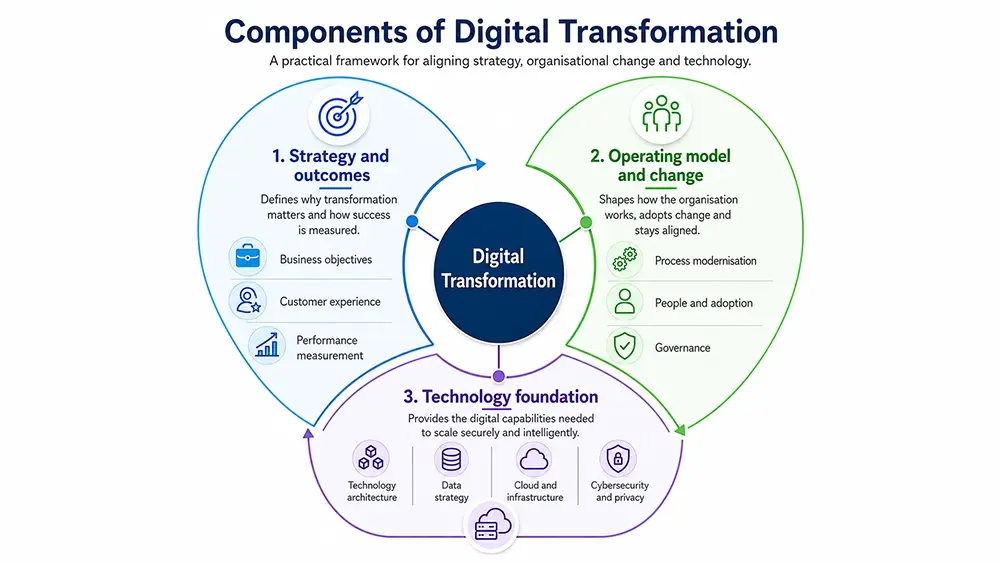
A modern data platform helps build governed information to support reporting, automation and AI. Microsoft business applications connect customers, finance and operations, while Microsoft Power Platform supports low-code apps, automation and business intelligence.
AI should be introduced only after the organisation has defined suitable use cases, data access, security controls, and success measures. Microsoft’s Copilot documentation recommends assessing organisational readiness and establishing a secure, governed data foundation before deployment — a sequencing point that applies just as much to AI consulting services engagements as it does to in-house projects.
Security and privacy should also be built into the strategy from the beginning rather than added shortly before launching. The Australian Signals Directorate recommends implementing the Essential Eight using a risk-based approach and setting a maturity target appropriate to the organisation’s environment. It also notes that the Essential Eight represents a minimum set of preventative measures and will not address every cyberthreat.
The Office of the Australian Information Commissioner recommends a privacy-by-design approach, where privacy is considered throughout the design of technology, infrastructure and business processes.
A digital transformation strategy framework helps businesses transition from current state to a phased delivery for a measurable improvement. Strong digital transformation models consistently align business outcomes, technology architecture, governance, and employee adoption.
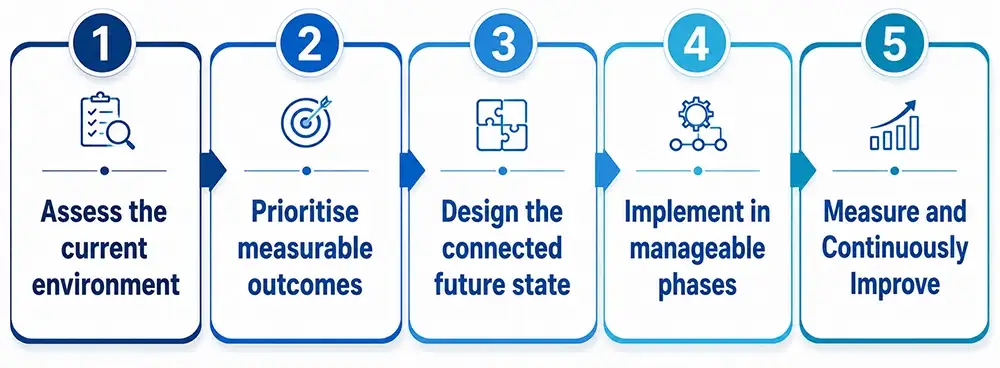
The starting point is understanding how the organisation operates. This means looking at:
In the second step, the findings are translated into focused business priorities.
At this step, businesses must define how processes, applications, data, security, and governance should work together.
The Microsoft Cloud Adoption Framework provides a useful structure across strategy, planning, readiness, adoption, governance, security and management.
The future state may include cloud architecture, identity, integration, data governance, backup, and AI controls. Each initiative should move the business towards a connected environment. A structured digital transformation services engagement can help translate this future state into a realistic roadmap.
Modernising everything at once increases costs and change fatigue. Each strategic phase should deliver a visible result, with employees participating in design, testing, and rollout. A practical sequence should:
Digital transformation does not end when a platform goes live. It continuously tracks process cycle time, reduces manual hours, minimises error rates, improves customer response time, aids in reporting preparation, increases employee adoption, lowers data-quality issues, balances technology cost and improvements in capacity, revenue or margin.
When results are below expectations, review the process, user experience, training and governance before purchasing another tool.
Transformation introduces new applications, identities, integrations and external access points. Security and privacy should therefore be designed in from the beginning.
In 2024–25, 21% of Australian businesses reported experiencing a cybersecurity incident.
Depending on risk, a roadmap may address:
Most programs fail because of weak ownership, excessive scope, poor data or low employee adoption. Businesses may reduce risks through accountable owners, realistic scope, and continued optimisation post launch. Here is a challenge-solution mapping useful for your business:
Consider a growing Australian professional-services business with spreadsheet sales tracking, documents scattered across email and shared drives, separate finance and project systems, and manually consolidated reports.
As the business adds locations, sales cannot see delivery capacity; operations receive incomplete handovers, finance finds billing issues late, and employees struggle to locate current information.
A phased roadmap could:
Illustratively, reporting might fall from two days to two hours and contract approval from five days to one. The same pattern shows up in the not-for-profit sector, where fragmented donors and grant data create similar strains. The outcome is a connected operating environment – not simply a new technology stack.
Effective digital transformation consulting prioritises business value before platforms. Beyond Key helps Australian businesses and not-for-profits assess capabilities, identify high-value use cases and build phased roadmaps across applications, data, cloud, automation, AI and change.
An engagement may include:
Beyond Key’s digital transformation services balance practical quick wins with the foundations required for scalable growth.
Businesses rarely struggle because they lack technology. They struggle because technology evolves faster than the operating model behind it.
A digital transformation strategy closes that gap by turning disconnected systems into connected capabilities, manual activity into scalable processes, and fragmented information into trusted insight. The strongest strategies begin by asking, “What must our business become capable of doing?”
Beyond Key Australia brings together technical depth and business consulting to help organisations put AI to deployment. We help organisations implement AI solutions across the Microsoft ecosystem, including Azure AI, Microsoft Fabric, Dynamics 365, Microsoft 365, Power Platform, Databricks, and Snowflake environments.
Get in touch with us to assess your environment, prioritise high-value opportunities, and build a practical roadmap.
It should include business objectives, a current-state assessment, process priorities, technology and data architecture, cybersecurity and privacy controls, change management, governance, a phased roadmap and measurable performance indicators.
No. Growing small and mid-sized businesses often benefit because manual processes become harder to control as customer numbers, transactions, employees and locations increase.
A focused initiative may produce results within several months, while an organisation-wide program may continue over several years. A phased roadmap allows the business to measure value throughout the journey.
Measure reduced processing time, fewer errors, faster reporting, improved customer response, employee adoption, stronger security, and increased operating capacity.
Digitisation converts information or an existing task into digital form. Digital transformation redesigns h[UC6.1]ow people, processes, systems, and data work together to improve performance.
Cost depends on organisational size, system complexity, scope, and whether the engagement covers assessment, roadmap development, or implementation. Phased planning helps the business prioritise high-value work before committing to a large program.


Falguni Puranik is a Marketing Manager at Beyond Key, with 14+ years of experience in enterprise solutions and B2B tech. She specializes in strategy, storytelling, content, and campaigns that simplify technologies like Power BI, M365, Dynamics 365, data visualization, and AI-driven transformation into real business use cases. She holds an MBA in Marketing Management
Work with a strategic IT consulting services partner that understands Australia’s modernisation, security and AI landscape.

Beyond Key Pty Ltd
Unit 605, 354 Church Street Parramattu, Sydney, NSW 2150, Australia
We acknowledge the enduring connection of Aboriginal and Torres Strait Islander peoples to the lands, waterways, and skies of Australia, pay respect to Elders past and present, and commit to a shared, inclusive future.
© 2026 Beyond Key. All rights reserved.


Falguni Puranik