Category:
Data Platform Services
Date Posted:
June 1, 2026

Data Platform Services
June 1, 2026
Table of Contents
ToggleA data platform is the infrastructure that connects all the places your business data lives and makes it usable – consistently, securely, and on scale. It brings together your ERP, your CRM, your cloud apps, your operational databases, and everything else into one governed foundation. One place where business users, data teams, and AI models can all access the same information. A modern data platform handles six things:
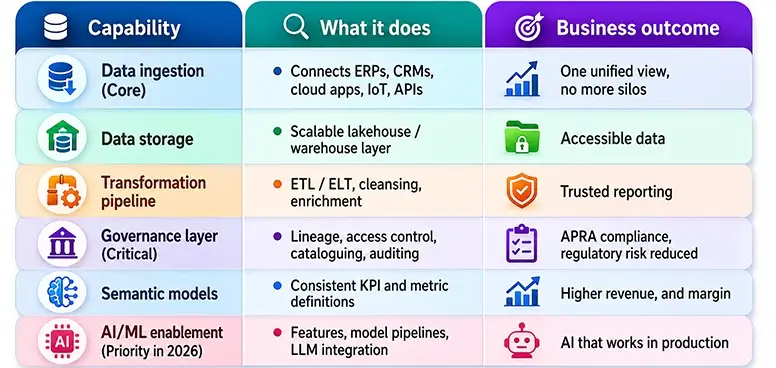
Generative AI and predictive models require clean, connected, and governed data on a scale. Without a solid data platform, your AI is only as good as your worst data source.
Self-service analytics provides real-time operational visibility for executives to enable quicker responses in hours, and not weeks.
APRA CPS 230 and 234, the Privacy Act, and ESG reporting all demand data lineage and auditability. A data platform helps in making compliance systematic.
Consolidating duplicated tooling, automating pipelines, and rationalising cloud spend helps with 30%- 40% infrastructure cost reduction within 12 months.
Empower marketing, finance, and operations teams to answer their own data questions -without engineering support through governed, discoverable data products.
A well-architected data platform scales your business along with new data sources, new regions, new products without rebuilding infrastructure (every 18 months).
72% of Australian CDAOs say AI has not met ROI expectations
If your primary need is reliable BI reporting on structured operational data (finance, sales, operations), a warehouse remains the right tool, with Snowflake platforms being the right choice here.
Financial services providers can anticipate client needs, automate follow-ups and improve retention. Firms like Insurance Advisernet Australia use the platform to give local advisors a 360-degree view of their clients.
Automation handles the KYC validation and follow-ups seamlessly. This frees up advisors to focus on high-value advice rather than chasing paperwork, which directly increases customer retention rates.
If you have large volumes of raw, unstructured data like logs, sensor data, and media files that require exploration and machine learning, a data lake provides cost-efficient storage and flexibility to users.
If you need both – reliable BI reporting and AI/ML workloads on the same underlying data with strong governance, the lakehouse is the best choice in 2026. Platforms like Microsoft Fabric and Databricks Delta Lake are purpose-built for this business needs.
For most ANZ enterprise organisations in 2026, the lakehouse architecture offers the best balance of performance, governance, and AI readiness without the duplication costs of maintaining a warehouse and a lake separately.
The right choice of data platform depends on your existing technology stack, AI goals, governance requirements, and organisational capability. Here’s how the leading platforms are deployed for ANZ organisations:
| Platform | Best for | Strengths | Considerations |
|---|---|---|---|
| Microsoft Fabric | Organisations already running on Microsoft |
|
Copilot AI enablement: email summaries, draft replies, flag stalled deals. |
| Databricks | Organisations with high AI and data engineering goals |
|
Organisations without experienced data engineers running this platform will end up underutilising it and overpaying for what they’re using. |
| .Snowflake | Organisations where data sharing and governance come first |
|
Best suited for structured analytics, regulatory compliance, and cross-organisation data sharing. Not ideal for bespoke AI solutions. |
Buying a platform license before defining business outcomes is the most common and costly mistake businesses make. Technology should always follow the strategy and not define it. Organisations that start by asking “which platform?” before “what do we need to achieve?” mostly fail with data platforms.
Governance retrofitted in phase III after the fact is exponentially harder and more expensive than governance that is designed in from day one. Every organisation that has tried to add it later has paid for that decision twice – one to build, and the other to fix it.
A data platform won’t fix poor data quality, but it will amplify it on a scale. Poor input creates poor insights at enterprise velocity. Data cleansing and quality management must be part of the migration plan from week one, not a second priority left to be resolved by itself.
A beautifully architected platform that only the data team uses delivers no business value. Change management and business-user onboarding must be treated as main deliverables and not just a training session scheduled for go-live week.
Organisations often try to solve every future data problem on day one. A phased, iterative approach that delivers value quickly, scales and outperforms the architecture project every time, with business value realising in 90 days.
When data is treated as an IT asset rather than a business asset, data quality and usage both suffer. Every domain requires business-side ownership and not just technical stewardship. Without it, governance becomes IT policing rather than an organisational capability.
Connecting legacy ERPs, CRMs, and operational systems to a modern workplace platform is almost always more complex than initial estimates. The edge cases and undocumented system behaviours discovered during integration are where programs lose time and budget, so it is always better to plan it early.
Before choosing a platform or starting a program, it helps to understand where you’re starting from. Most enterprises don’t realise they’ve outgrown their current architecture until the risks become unavoidable.
Most data platform programs fail for any of the two reasons: they start with a platform selection instead of a business problem, or they treat governance as something to set up after go-live. We’ve seen both produce the same result – a technically complete platform the business doesn’t trust and eventually stops using.
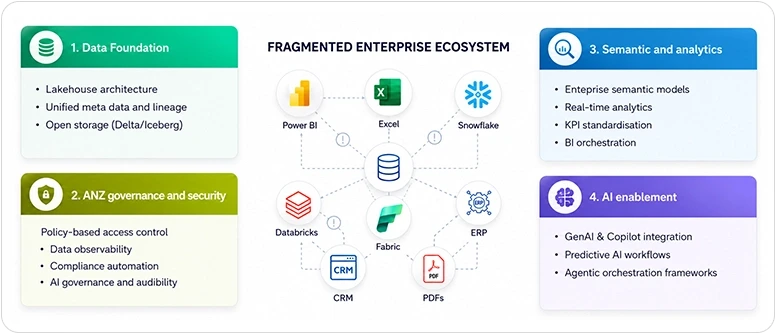
Beyond key’s Enterprise AI-readiness journey
Eliminate duplication at source by consolidating data from ERP, CRM, cloud apps, databases, and IoT into one scalable, governed foundation.
Embed lineage, access control, semantic consistency, and quality monitoring from day one, right in the foundation.
Deploy Power BI, self-service analytics, and executive reporting into the platform directly.
Enable predictive analytics, ML, GenAI apps, and natural language querying on a foundation the business already trusts.
Here is the framework that most data consultants follow for successful data platform programs in 2026 and beyond:
The question is no longer whether your business has data. The real question is whether your data foundation is ready for AI, governance, and scalable growth. Businesses that modernise now will be significantly better positioned to operationalise AI, improve decision-making, and reduce long-term technology complexity.
Data platform is the layer of infrastructure that sits between your source systems and the people and tools that consume data. It handles ingestion, storage, transformation, governance, and delivery as an architecture, not a single product.
Because every tool you add without a data platform creates another version of the truth. At one stage you will find that the cost of reconciling those versions will show in increased time, trust versions, and failed AI projects which exceeds the cost of fixing the foundation itself.
In ANZ, Microsoft Fabric is suitable for Microsoft-first organisations. Databricks is preferred for teams with serious AI and ML engineering capability. Snowflake is chosen where governed data sharing across business units or partners is the priority. All three are legitimate, but the right choice depends on your stack and not the market's popularity.
Microsoft Fabric, Databricks, Snowflake, Google BigQuery, Azure Synapse, and AWS Redshift are some examples of commonly used data platforms.
Microsoft Fabric comes up most often in ANZ simply because the Microsoft ecosystem for Azure, M365, Power BI is already embedded in most mid-to-large enterprises her.e Databricks and Snowflake are the next two most common alternatives depending on whether AI engineering or governed analytics is a priority.
Microsoft Fabric, Snowflake, and Databricks all support role-based access control, data encryption at rest and in transit, audit logging, and integration with enterprise identity providers. For APRA-regulated organisations specifically, the governance and lineage capabilities matter as much as the security controls themselves.
Beyond Key Australia delivers end-to-end data platform programs across ANZ from architecture and platform selection through to governance design, migration, and AI enablement. We work across Microsoft Fabric, Databricks, and Snowflake depending on what best fits the client's environment.


Falguni Puranik is a Marketing Manager at Beyond Key, with 14+ years of experience in enterprise solutions and B2B tech. She specializes in strategy, storytelling, content, and campaigns that simplify technologies like Power BI, M365, Dynamics 365, data visualization, and AI-driven transformation into real business use cases. She holds an MBA in Marketing Management
Work with a strategic IT consulting services partner that understands Australia’s modernisation, security and AI landscape.

Beyond Key Pty Ltd
Unit 605, 354 Church Street Parramattu, Sydney, NSW 2150, Australia
We acknowledge the enduring connection of Aboriginal and Torres Strait Islander peoples to the lands, waterways, and skies of Australia, pay respect to Elders past and present, and commit to a shared, inclusive future.
© 2026 Beyond Key. All rights reserved.



Falguni Puranik